| Botanic name | Eucalyptus woodwardii |
| Other names | Lemon-flowered gum, lemon-flowered mallee, gungurra |
| Main Origin | Desert zone of southern Western Australia |
| Mature size | 3 – 5 m x 8 – 20 m (w x h) |
| Mature form | Small to large tree with a rounded, open canopy |
| Foliage | Spear-shaped, blue-grey or grey-green |
| Growth rate | Moderate to fast |
| Position | Full sun |
| Soil | Adapts to most soils |
| Water | Supplemental watering during extended dry periods |
| Climate | Arid, semi-arid, Mediterranean, warm temperate |
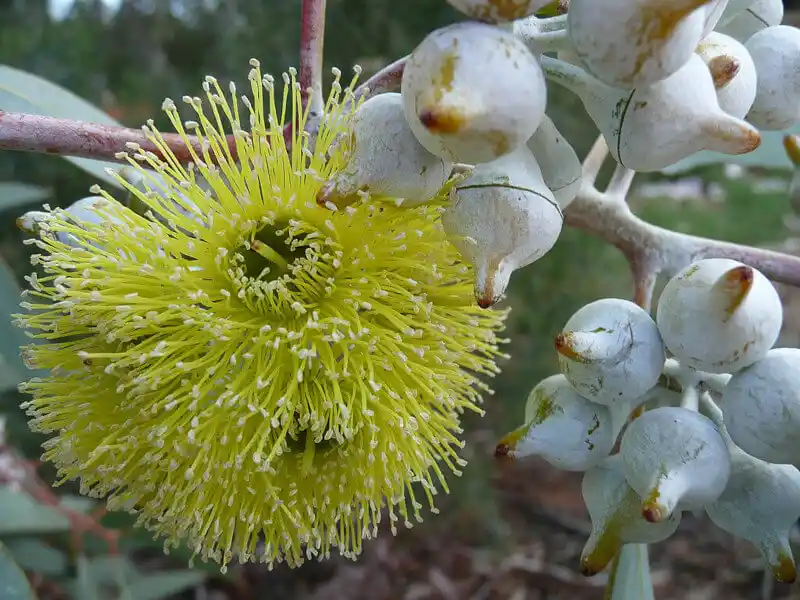
| Flower | Vibrant lemon-yellow flowers from late winter to spring |
| Use | Feature specimen, windbreaks, avenue planting |
| Notes | Suitable for coastal sites |
IN THIS ARTICLE
Overview
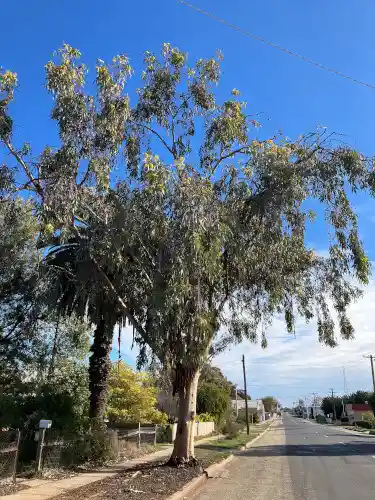
Eucalyptus woodwardii, or Lemon-flowered Gum, stands out in arid landscapes with its frosted, grey-green leaves and a graceful weeping form. Native to the harsh desert of Western Australia, it thrives where few others can.
Tough and drought-tolerant, this eucalypt is gaining popularity in modern landscaping with its architectural elegance, especially for residential gardens and streetscapes in harsh, dry climates where resilience is paramount.
Origin and distribution
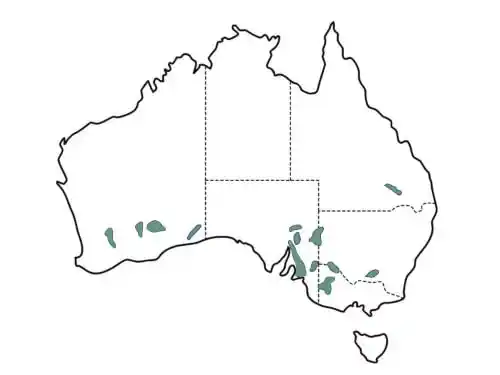
Eucalyptus woodwardii is endemic to the desert zone of southern Western Australia, where it grows in sand or deep sandy loam. Lemon-flowered Gum is a popular ornamental tree in drier parts of southern Australia.
Because of wide cultivation, the species has become naturalised in western Victoria. Given its reputation as one of the most spectacular arid-zone trees, Eucalyptus woodwardii is also widely cultivated in low-rainfall regions abroad.
Growth and care
Eucalyptus woodwardii is well adapted to withstand prolonged drought and intense heat. It thrives best in warm Mediterranean, temperate, arid or semi-arid climates, making it ideal for regions with hot, dry summers and mild winters. The species dislikes high humidity.
It can handle light to moderate frost and low temperatures down to -5°C once established, but cannot survive in severe or prolonged frosty, freezing conditions.
Eucalyptus woodwardii is a desert-adapted species thriving on sandy soil with low organic matter. In cultivation, it is highly adaptable to different soil types, including gravel and heavy clay soils, so long as drainage is adequate. The plant doesn’t do well if overwatered.
While it can tolerate moderate soil salinity and coastal exposure, it is ideal for less exposed seaside gardens, as Lemon-flowered Gum is not a frontline coastal species. Also, it prefers slightly acidic to neutral soils, but can handle alkaline soils.
Eucalyptus woodwardii flourishes in poor soil. Fertilisation is not often required. Organic matter from the slow decomposition of leaf litter or mulch is sufficient for robust growth. Overfertilising can do more harm than good.
The tree also requires minimal pruning, as its natural form is quite attractive, and excessive pruning can disrupt the plant’s visual appeal. However, formative pruning on a young tree can encourage a strong, single leader and an open, balanced framework.
Features
Although naturally a mallee, Eucalyptus woodwardii often develops a single trunk with an upright form and a neat, open canopy that spreads gracefully, typically reaching 5 – 10 metres in home gardens. Its sturdy frame is clad in smooth bark that peels away in ribbons, exposing layers of soft pinkish-red to rich coppery brown beneath.
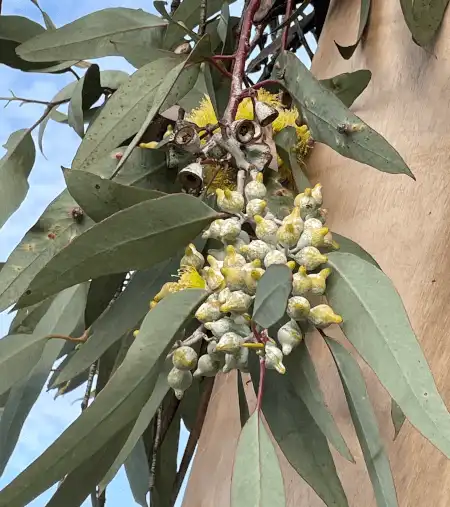
One of its most distinctive characteristics is its graceful, pendulous branchlets, adorned with attractive, spear-shaped, blue-grey or grey-green foliage, creating a soft, almost ethereal silhouette. This weeping habit contributes significantly to the tree’s ornamental appeal.
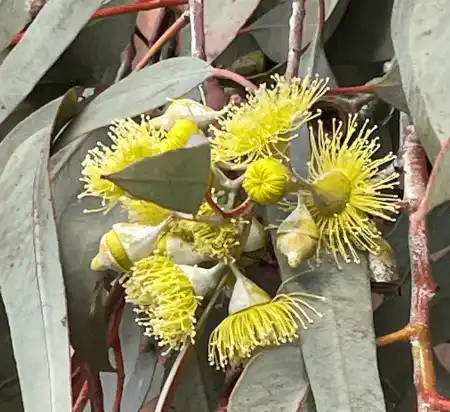
The most captivating feature is its spectacular blooming. An abundance of vibrant, eye-catching, lemon-yellow flowers emerges in large clusters from late winter to spring, creating a breathtaking display that brightens the landscape.
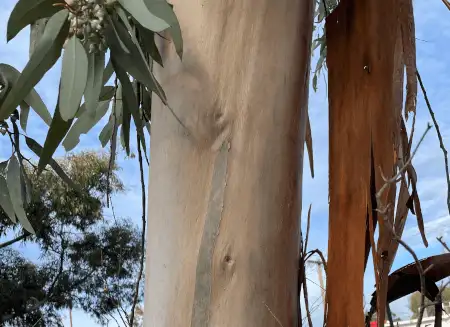
Following the stunning flowers, E. woodwardii develops large, woody gumnuts. These are urn-shaped to bell-shaped, prominently ribbed, and can be quite ornamental in their own right.
Low-maintenance, drought-tolerant, and visually striking year-round, Eucalyptus woodwardii offers contemporary gardens a unique aesthetic that blends Australian character with sleek design sensibilities.
Eucalyptus ‘Torwood’
Eucalyptus ‘Torwood’ is a naturally occurring hybrid between Eucalyptus woodwardii (Lemon-flowered Gum) and Eucalyptus torquata (Coral Gum). Both parent species are endemic to Western Australia, though they do not naturally overlap in their wild distributions.
The hybrid is believed to have first appeared in cultivation, specifically in a schoolyard in North Kalgoorlie, where both parents were planted.
This hybrid combines desirable traits from both parents, resulting in a tree with its own unique and highly ornamental characteristics.
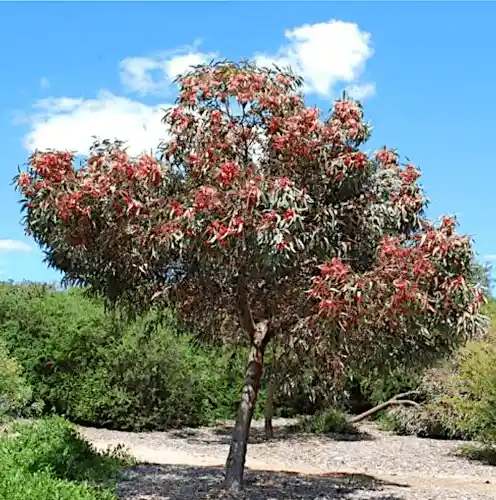
- Attractive foliage and bark: The tree features blue-green to dull green foliage and often has smooth bark that can display attractive orange or coppery hues.
- Striking flowers: Blended with the consistent lemon-yellow of Eucalyptus woodwardii and coral-pink to red of Eucalyptus torquata, its blooms are a breathtaking array of yellow, orange, scarlet, and even pinkish-red.
- Prolific flowering: It inherits the showy, abundant flowering habit from both parents, leading to masses of eye-catching blooms, often appearing in spring and summer, with sporadic flowering throughout the year.
- Manageable size: ‘Torwood’ is one of the small eucalyptus trees, ideal for smaller gardens and street tree planting.
- Excellent hardiness: ‘Torwood’ retains the hardiness of its parent species. It is extremely drought-tolerant once established.
‘Torwood’ is a popular choice for gardeners and landscapers seeking a low-maintenance eucalypt that offers an even more diverse and brilliant floral display than its parent, Eucalyptus woodwardii, while maintaining a suitable size for urban environments.